

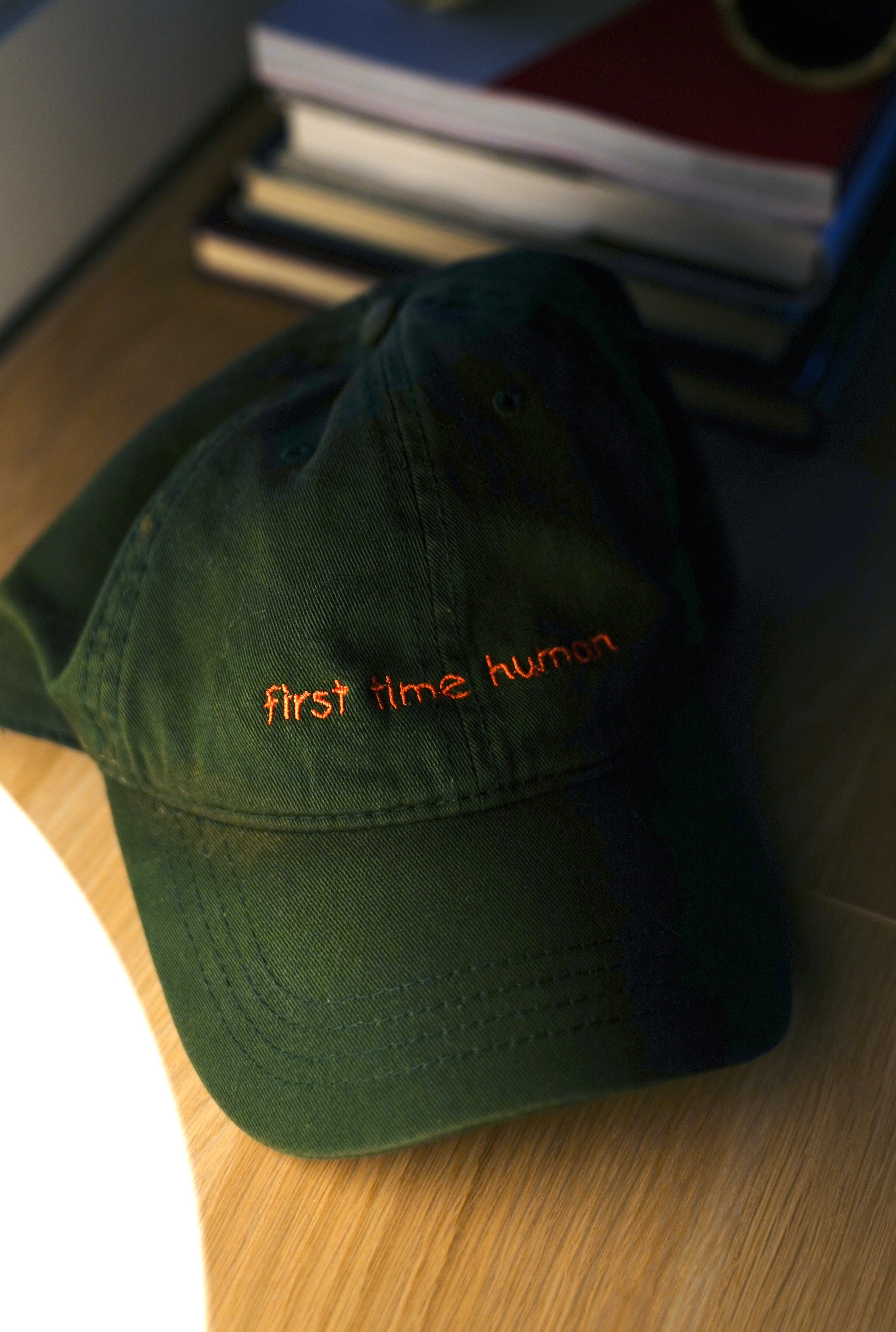
first time human
After a friend shared how life can be understood as inhales and exhales, the idea of "breathing" has been lingering on my mind for the past two weeks.

I’ve always understood the importance of breathing. But I’ve only ever practiced breath in the moment — as recalibration for the body and mind:
Cycling up a
                                             p
                                          e
                                       e
                                    t
                                 s
                                                       climb.

                Running long                                         distances.

S t r e t c h i n g on the ground.

                                  after a stressful work meeting.
                   and
Before
These are meditative moments that keep me grounded in the present. But how might this breathing apply to life as a whole, when “these days” can be understood as inhales and exhales?
The Artist’s Way by Julia Cameron has been helping give words to these feelings (thank you to all who keep sharing their experiences with it) and it’s been a long time since I’ve last written as much as I am currently. I’m getting used to babbling out loud, being okay that my early writing may have sprawling ideas, and that the connections between them might be unclear. But that’s part of what makes this stuff honestly authentic.
I could record myself in front of a camera and talk about this topic at length, yet something about the reality of how I speak falls short. The tone of my voice. The pace of my sentences. The way my body moves. The assumptions people make about who I am. It can all mask the message I’m trying to express.
Maybe I’ll practice and “redesign” this superficial part of me better. But for now, how I write exposes more of what I mean.
So here are some words on how my new practice in breathing has been going — through three geographies of my life so far, rural, urban, the in-between, and explore how those landscapes shape the way I think, feel, and create.
the long breath out
A few years ago, before moving back to New England, I bought a physical copy of Robert Frost’s New Hampshire and his other poems at McNally Jackson Books in NYC. I didn’t know it at the time, but I was hoping his words might help me make sense of the place I grew up and once called home. A poetic field guide, maybe. A way to understand the land, and myself in it.
He contrasts rural life with the city, praising the wisdom that comes from hands-on, daily living — rooted, unhurried, hard-earned. There’s admiration for the people here, even a kind of reverence. He writes like someone who’s become the landscape.
I thought I shared many of his values…with lines that feel a little too relevant:
“The only person really soiled with trade
I ever stumbled on in old New Hampshire
Was someone who had just come back ashamed
From selling things in California.”
The poem even ends with:
“It’s restful to arrive at a decision,
And restful just to think about New Hampshire.
At present I am living in Vermont.”
After seven years in San Francisco, I was ready for that. I wanted a return to something simpler. The “realness” of Vermont.
I romanticized the rhythm of small towns — raking leaves and shoveling snow, rugged winter boots and jackets, muddy roads and humid evening thunderstorms, neighbors we’re close with, familiar faces at the farmer’s market, and long drives to do errands or see loved ones in a different town.
I thought about how I took this life for granted growing up. I could smell the fresh morning breeze. I could hear the wildlife dominate the outdoors. I could see the rolling hills of trees come back to life in the spring. I could feel sunlight warm the cool air. I wondered why I ever left.
When I experience reality, I exhale.
But underneath all that nostalgia, a different feeling began to surface: sadness. A kind of emptiness.
Not boredom. Not even loneliness. But a strange disconnection from inspiration. I was missing a sense that the life I returned to was no longer quite mine.
Vermont is proud of its generational identity. There’s a certain belonging that’s inherited, not invited. I grew up in this region, but I don’t feel of it. I’m respected, but not included. Present, but not heard. In the room, but not in the circle.
I’ve found myself in spaces where change is spoken of, but rarely embraced.
Where my values are admired like exhibits—glanced at, nodded to—but never touched.
It feels like I’m a museum piece. A curated life. A thing to be appreciated, not engaged with.
And the longer I stay in that posture, the more stubborn I become.
When I experience reality, I exhale.
If for too long, I forget to change how I think.
the deep breath in
If Vermont represented an exhale — a quieter, grounded life — then California has always felt like an inhale. A swelling in the chest. A rush of intellectual and cultural air.
I was born in Los Angeles. I grew up in New Hampshire.
I spent a third of my life in California. My family is from the Philippines.
I speak perfect English, and almost no Tagalog.
I am the A in API, the POC in BIPOC, the checkbox on government forms.
In America, I am a “minority.”
In all of New England, I am one of 50,000 Filipino Americans. In just the Bay Area, I was one of 500,000.
That label softened in San Francisco. I wasn’t just a statistic, I was part of the community. My face, my story, my culture weren’t unique; they were woven in. There, the spotlight wasn’t on me, it was on what I brought with me. How I thought. How I showed up in the swirl of collective intellect and intention.
In the city, individuality wasn’t just tolerated — it was the whole point. The way we thought became our shared language. Our histories, traumas, dreams, all orchestrated into conversations like music. Our cerebral costumes made of our past experiences, our beliefs for the future, all twirling in the dance of the present.
When I think about life, I inhale.
To live in the city was to participate in a shared magic. The city felt like a living museum with artifacts left for others to help us navigate this world. Every street, every conversation, a curated guide to how to live. Every piece, every word, every perspective was something I could pick up and use.
But even there, something hollow crept in.
I find myself thinking more than doing, over-intelectualizing the essentials. I consume, I theorize, I admire, I change my perspective. Experiences and ideas reused, recycled, reinterpreted. Analyzing and critiquing. Acting, but never acting on.
I find myself lost in the performance. Floating on feelings. Hovering in thought. My beliefs protected from dissent, but my faith devoured of meaning.
When I think about life, I inhale.
If for too long, I forget to change my reality.
the time in-between
So what about a life between the inhale and the exhale?
Bi-coastal. A third space where both could coexist. It felt like the perfect balance, like I was building a life with the best of both east and west.
When snow stretched into March, we’d fly back to California to watch the golden hills turn green. When wildfire smoke thickened in September, we’d return to Vermont for crisp air and red leaves. When rain took over December, we’d come back to a winter wonderland and cozy up on the couch.
I could control and optimize this life in transition, on my own time and schedule. But even with all its flexibility, the in-between became its own kind of dissonance.
When my existence is in transition, I hold my breath.
I started accumulating doubles — two bikes, two mugs, two monitors. Our belongings split between an apartment and a house. Two lives, mirrored. Two homes, but no hearth.
At first, it felt like freedom. Then it felt like fragmentation. It often felt like I lived out of a suitcase — always missing something I’d left on the opposite coast. The illusion of control. The illusion of balance.
I told myself I was changing, voluntarily. That this constant movement was growth.
But in hindsight, I see it now:
It was a way to stay untouched.
A life curated for observation, not transformation.
I became a guest in every place I lived.
Close to communities, but never inside them.
Close to presence, but never quite grounded.
Convenience in friends, but never in depth.
I shared my reality only with others who floated in the ether — nomads, chronic travelers, thoughtful people suspended between something and somewhere. When our paths crossed, a fleeting moment of connection, our need for belonging tethered by our digital identities.
We shared a mantra: “Find comfort in the uncomfortable.”
But over time, that became a shield. An unchanging change, a way to protect myself from the unplanned, the vulnerable, the truly rooted. I felt no different from a tourist. I was always moving, seeing something new, being in the moment, but never fully living. In the end, I return to a home, but it rarely feels like I ever arrived.
When my existence is in transition, I hold my breath.
If for too long, I forget to breathe at all.
So I continue breathing, and the cycle continues. Forever balancing between thinking and being. Between philosophy and physicality. Between California and Vermont. Between designing a life and simply living it.
“I go no further than I have to go
To find a mind that’s disillusioned in
The cultivation of the philosophic mind.”- Robert Frost, New Hampshire
It’s my first time in this life, and I’m still finding the rhythm to breathe, in a way that beats and resonates in my soul.
-pips